


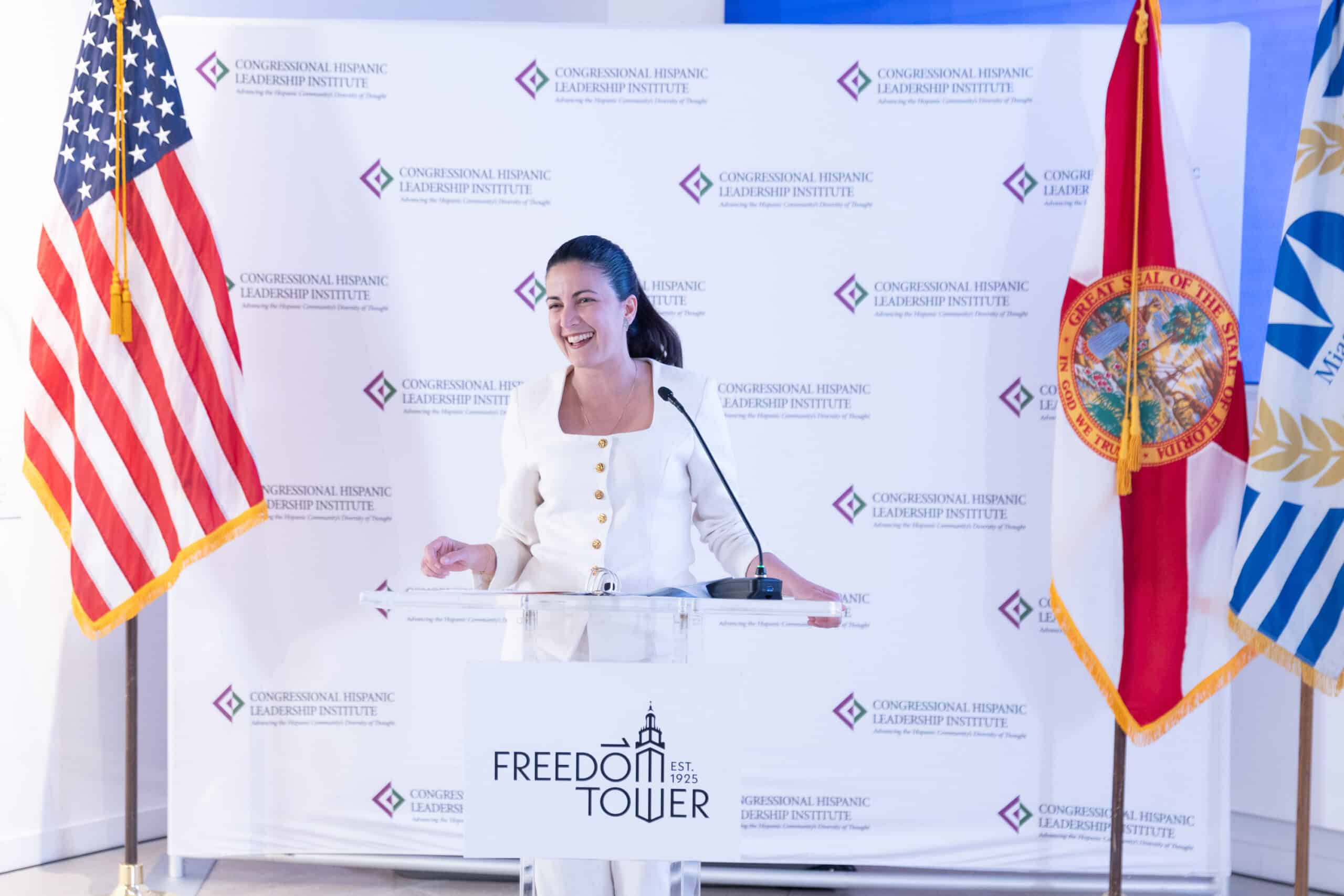
Good evening.
My gratitude to CHLI for bringing together in this extraordinary building so many leaders who believe in freedom and promote it as a fundamental part of our shared humanity. Thank you. I am especially moved tonight because CHLI stands as a powerful example of what Hispanics-and Cubans in particular-can build in a free society. It was an honor to receive the Founders Award in 2020, established by three extraordinary leaders: my dear friend, the visionary Lincoln Díaz-Balart, who is no longer with us; the steadfast lleana Ros-Lehtinen; and the strategist, our congressman Mario Díaz-Balart. They have long been a reference and a guiding light in my personal journey and in the Cuban people’s struggle for freedom. And there is something deeply meaningful about gathering here, at the Freedom Tower. This building welcomed Cuban exiles who arrived with nothing but the conviction that freedom was worth crossing the sea for. That is exactly why we need to talk about Cuba tonight with a sense of urgency, because that story is not finished. In Cuba today, the lights go out for most of the day and night. Nine of the country’s sixteen power plants are not operational – either broken down or starved of fuel. Families cook on charcoal and wood in their patios, sharing the fire with their neighbors. Hospitals struggle to keep their equipment on. Cubans are living a humanitarian catastrophe caused by the regime. A regime keeps asking the people to endure a new “special period”-as if the scarcity imposed by a failed system were just a passing season. They learned nothing. They changed nothing. They doubled down on control and repression.
Here is what we need to understand: the crisis is the predictable result of over 67 years of communist dictatorship. And the worst crisis of all is political. Nearly one thousand political prisoners remain behind bars simply for expressing their ideas. Teenagers have been imprisoned over a Facebook post. Mothers have been sentenced for shouting “Freedom” in the streets. Young men have been killed inside prison walls. In just the last four years, my country has lost nearly one and a half million people, that is more than 12% of our population. Cubans are literally disappearing from the Island. It feels like the ultimate metaphor of communist oppression… except it is not a metaphor. It is concrete. It is literal. And it is devastating. And yet – despite death, hunger, repression and forced exile, the Cuban people do not surrender. We are convinced that the only way out of this crisis is the end of the dictatorship.
The Cuban people know this. And, although we do not see it on the news every day, they are fighting. This past year, more than 11,000 protests were registered. That is a 25% increase from 2024 and represents about 30 public protests every single day. Cubans on the island continue to organize, and to demand change. They bang pots in the dark. They paint walls. They film themselves and send videos out through whatever signal they can find. The demand for change is not an external call. It is rising from within the Cuban nation, on the Island and in exile.
The strongest allies of the Cuban people are the government and the people of the United States, because bringing an end to the Cuban regime is not only a moral imperative-it is a strategic necessity. The Cuban regime is behind the largest migratory crises in the hemisphere (from both Cuba & Venezuela) and the most significant intelligence penetrations in the US government. Havana is a partner in the narcotrafficking networks operating throughout the region, and a sanctuary for terrorists around the globe. Havana is also Moscow and Beijing’s closest ally in our hemisphere, not to mention the Chinese espionage bases operating from Cuban territory. As President Trump’s Executive Order states, the actions of the Cuban regime constitute an extraordinary threat to the national security of the United States. In 2012, my father, Oswaldo Payá, was killed by the Castro brothers for demanding rights for the Cuban people and for embodying the alternative to the regime. He believed that Cubans could decide their own future through peaceful, democratic means. The regime feared that idea more than any army. They feared it because it was true. That idea did not die with him. It grew so much that today the main democratic forces of Cubaare uniting — and we have a plan.
We are united around a concrete transition roadmap – for liberation and stabilization, reconstruction and democratization. We want to be very clear: there can be no stabilization under repression in Cuba. This is not a wish list. It is a comprehensive transition plan-humanitarian, economic, and institutional. It begins with the recognition of rights for all cubans and freedom for political prisoners. It responds to the humanitarian emergency. It promotes national prosperity and human flourishing. It seeks national and familial reunification after decades of exile and the forced separation; and it will conclude with free, fair, and multi-party elections. The conditions for change are in place: 1. grassroots mobilization inside Cuba demanding freedom; 2. the construction of a credible alternative, a team ready to act the moment the regime fractures; and 3. mounting international pressure-made possible by the audacity and vision of the leaders of the United States government-bearing down on the regime’s archaic power structure. Today, we stand at the threshold of freedom. Cuba is the Berlin Wall of our time, and it is ready to fall. For the first time in decades, we can get this done. This is precisely why the people in this room matter so much. To the Members of Congress here tonight: the moment calls for policy as bold as the pressure. We need measures that cut the regime’s financial lifelines while humanitarian aid keeps reaching directly the people. And we need the United States to stand clearly alongside the Cuban democratic opposition as a partner supporting a solution that comes from within. To the corporate executives in this room: the private sector helped build democratic transitions in Eastern Europe and Latin America. From day one, your capacities and leadership will be essential to the stabilization and reconstruction of our country. When Cuba is free — and it will be free – it will need massive investment, institutions, and partners in building a democratic Cuba from the ground up. To the Consul Generals and university leaders: The struggle for a free Cuba is not only political—it is a struggle for truth, for personal liberation, and for the power of ideas. Your voices matter. Your platforms matter. The regime is trying to preserve the structure of repression while offering the appearance of change. The international community cannot accept that outcome. This is an existential struggle. We must answer propaganda with truth and fraud with liberation. I am here tonight because this is not just Cuba’s fight. It is the hemisphere’s fight. It is a test of whether we – all of us in positions of influence and responsibility – will meet this historic moment with the courage it demands. And I am asking each of you — in whatever capacity you serve to stand with us. The moment is now. And we will not let it pass. The lights may be out in Cuba. But my father was right, the night is not eternal, and the people are awake.
Thank you.